
The Triumvirate
The story of three misfits on a vast prairie
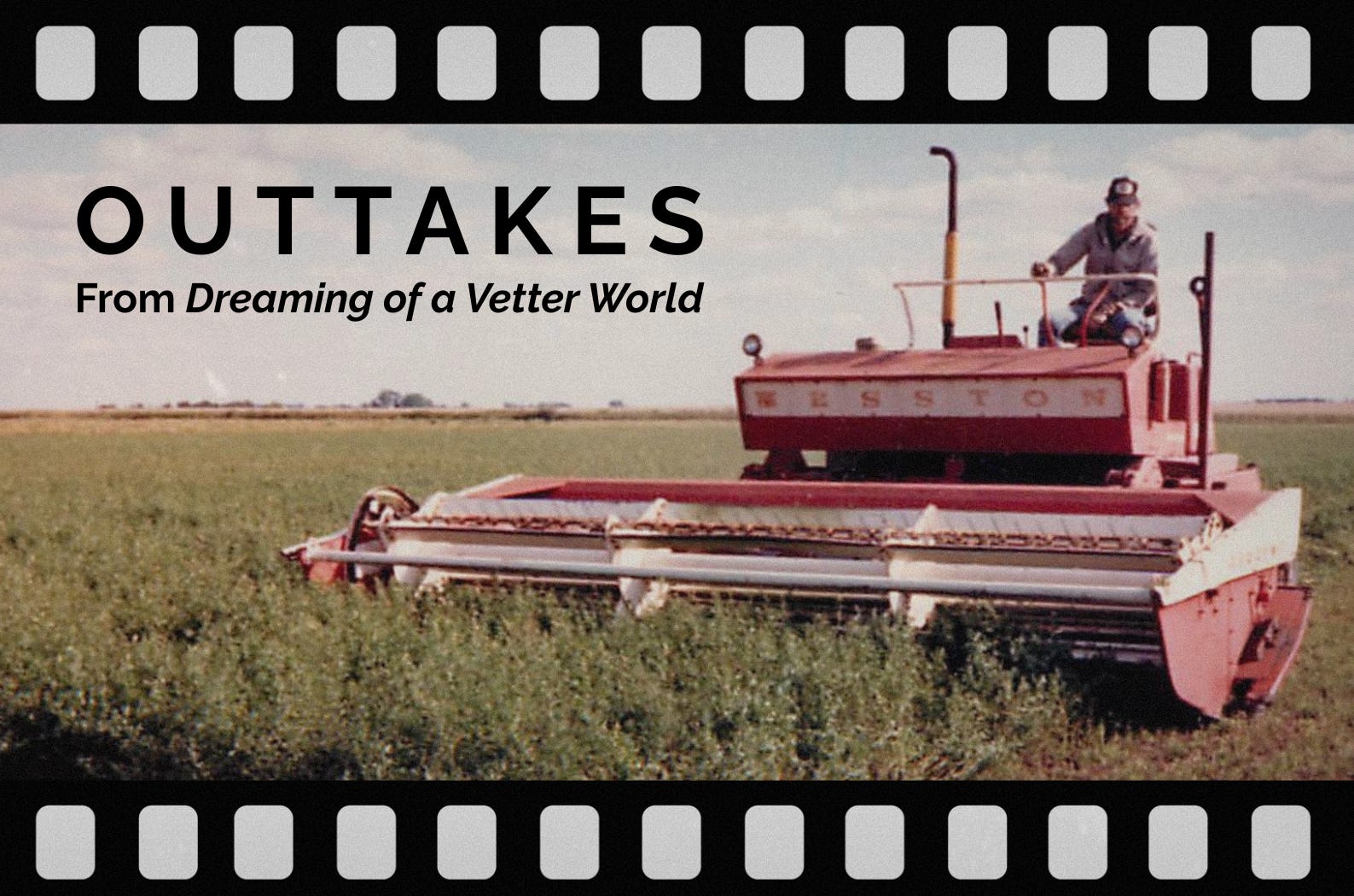
As the old saying goes, a lot of good stuff ends up on the cutting room floor.
Bonnie Hawthorne, the filmmaker of the documentary about the Vetter family farm, Dreaming of a Vetter World, shares some of those overlooked nuggets with us here.
“This segment was part of the original version of the film, before I recut it for time,” she says. “I always liked this story of how three guys grew up together and influenced each others’ lives as the years went by.”
Narrator:
…They also rotate their cattle, and it’s a big job.
David Vetter:
These guys move to a new paddock for about every three or four days. We rotate them around the farm and we’ve got enough paddocks that they’ll get back every 30 to 40 days, depending on weather conditions and pasture recovery.
Narrator:
As they graze and poop, a complex system of bugs and bacteria and sunlight and dying roots—left over from the grazed plants—help build that amazing water-storing soil.
Know what else soil’s good at storing? Carbon.
Bill Whitney:
We can sequester carbon in the soils through restorative actions in agriculture and forestry and grassland management.
Narrator:
The folks at Prairie Plains Resource Institute are all about that.
Bill Whitney and co-founder Jan Whitney are on a mission to restore prairie disrupted by agriculture.
Bill Whitney:
We collect over 200 species of native prairie and wetland seeds because we do what is called high-diversity prairie restoration.
Restoring grasslands is one of the tools that could work to mitigate climate change.
Grasslands build soil and soil creation involves the locking up of carbon in the ground. It’s a sustainable resource that if managed well can produce food and fiber. And I feel that the cultivation of marginal lands is a shortsighted process.
Narrator:
Nothing shortsighted about Bill Whitney’s vision. He grew up here, but it wasn’t until he came home with a master’s in science that he really saw the prairie.
His mission was to make a difference in his hometown, just like these two other jokers he knows.
Bill Whitney:
The triumvirate.
Narrator:
What’s the triumvirate?
Bill Whitney:
Oh, it was a, a self mocking triad of David, Ed, and me. We grew up here, we came back here, we got excited about a future here.
Narrator:
They were all sort of misfits in their community, but they understood each other.
Bill Whitney:
David had his ideas about food and agriculture, and I think it influenced a lot of what my wife Jan and I did in terms of grasslands and creating an organization to be on the landscape too. And so we felt, along the way, allied with the cause that David had.
Narrator:
And the mutual influence continues to this day.
David Vetter:
We’re experimenting with planting prairie grasses in our field borders to encourage pollinators and predator insects to assist us with pest management.
Narrator:
The third member of the triumvirate, artist Ed Dadey, helps the Vetter farm with all sorts of things.
David Vetter:
Ed Dadey works with us, on a part-time basis. Pretty much on his schedule. We have just special projects that we assign for him that may be equipment repair or modification or making parts.
Narrator:
Making parts is crucial ‘cause this is their most modern piece of farm equipment. And not by choice. Their combine is from the 1980s. Other stuff is even older.
The machines that work in their small field sizes, which are essential to their pest management and crop rotation, are no longer made in the U.S. Everything is scaled much bigger now.
Ed Dadey:
This is State of the Art 1940.
Narrator:
This old seed broadcaster still has plenty of life in it. With a little help from Ed.
Ed Dadey:
This was designed to do its job and nothing else, and do it simply do it efficiently. You just go out to the field daydream while you go around and round in the field in your tractor and it’s all done.
Narrator:
How does an artist know about daydreaming on a tractor? Ed grew up on the farm that is now Art Farm Nebraska: an artist residency.
Ed Dadey:
Art Farm is still partly conventionally farmed. Then you got half of it which is like undergoing dramatic change in a social way, which is, you know, cultivating culture if you wish.
I have no interest in the economic profits of agriculture, even though I do live on a farm and grow corn. My so-called profits basically equal the amount of tax due on the land.
David Vetter:
I would classify Ed as a farmer that’s probably a better big picture farmer than most farmers who farm full-time. That’s why conversations about farming are always useful with Ed.
Ed Dadey:
My parents, they were totally organic without knowing it.
A five-acre patch intensively farmed would get you as much as a 500-acre field extensively farmed.
It’s a cycle that you grow corn to feed your tractor.
What is the cost? Everything has a cost.
Proud to stand in a lineage of misfits. :)