
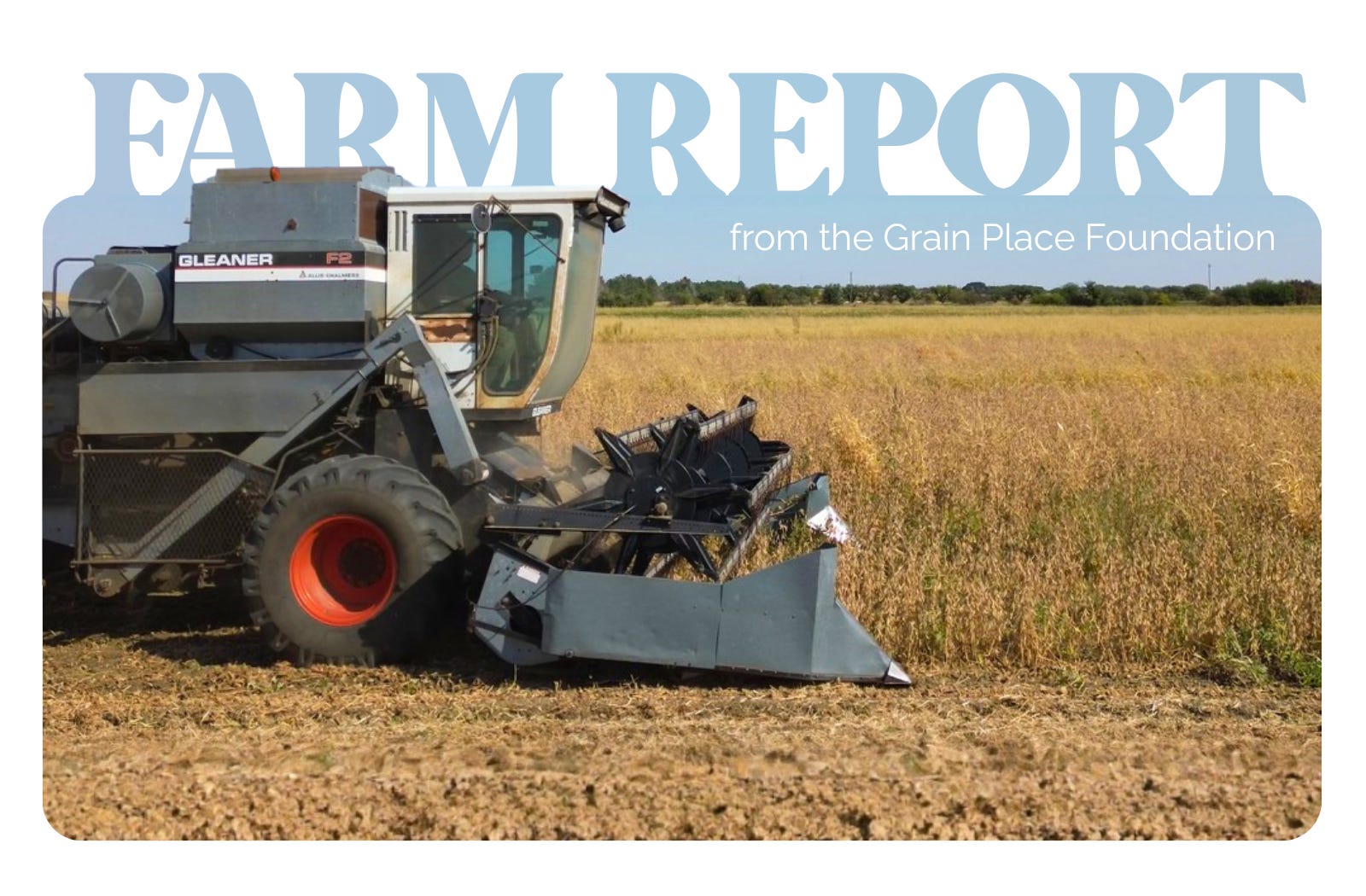
Here’s some context for this week’s Farm Report. The handwritten note on this 1980 magazine cover says, “Donald and David laying irrigation pipe.” That’s David Vetter and his dad, Donald Vetter.
Jay Goertzen is irrigating with some of these pipes today.
Transcript
MOLLY: Hey, Jay.
JAY: Hey, how are you today?
MOLLY: I’m good. How are you?
JAY: I’m doing pretty well.
MOLLY: Excellent. Where are you today?
JAY: I’m outside, but, I wanted to get by the pipe, ‘cause I wanted you guys to see what we’re doing today. We are irrigating. Here we go.
MOLLY: Excellent.
JAY: Water’s coming out. And yeah, we’ve got our pipeline. So yeah, we got the well started yesterday, and started irrigating a different field, and it ran, all night, working on that field. And then this morning we switched rows over, and now we’re, irrigating our second corn field. So that’s the... I know we talked about this probably been a couple weeks ago now that I said-
MOLLY:Yeah, yeah.
JAY: We’re getting ready for irrigating, and we had, a couple little sprinkles here and there. It’s been very, very hot, but the corn has held on really well. If any of you were at field day, I think David Meyer alluded to that, but the way the practices out here have affected the soil, and they have, very obviously affected the water retention properties. And so the corn has held on longer than I expected it to. I was kind of worried last week that we weren’t irrigating. but we went out and checked and it looked okay. We finally got going today, and everything still looks good. It was over 100 degrees yesterday out here, and the corn was barely curling at all, so... that’s a natural thing to see the corn, uh, leaves curl up a little bit, but they always say if they start to un- if they don’t uncurl overnight, that’s when you’re really in trouble. It feels good irrigating, to know that we’re doing what we can. the crop looks good, the corn looks good, and so we’re doing what we can with the resources that we have to take care of it, so it’s kind of fun.
MOLLY: So this is the first irrigating of the season?
JAY: Correct. Yep.
MOLLY: And will you irrigate other crops besides the corn, or just primarily corn? JAY: Yes, we will irrigate our soybeans. We’ll get over to those, this week yet if it doesn’t rain. There’s a really good chance of rain on Wednesday and Thursday, so we’re really hoping it does. But, but if it doesn’t rain, then we’ll for sure be irrigating those by the end of the week. The one field anyway. The other field was planted quite a bit later, and so that one has a little bit more time before we need to irrigate that one. But we’ll be doing these, the two corn fields that we’re working on now, and then we have one popcorn field, that we will, that will be the next one in line.
MOLLY: So this, this may be a silly question but you can only do one at a time?
JAY: Technically we could do two. We do have two wells, but yeah, otherwise it’s just one at a time. The amount of water it takes to get through a field, it’s more efficient to just run one field and get it done than to try to split your water between two of them. You know, it’s like anybody who has a lawn with underground sprinklers, they don’t all turn on at the same time. That’s kind of the same thing we do with, uh, with the irrigation well. But we do have two wells. We could run the other half of the field, but, I don’t know if they even used that one at all last year. It’s one of those deals like, we’ll do it if we’re getting really behind, but if we’re not..
MOLLY: Mm-hmm
JAY: We’d rather just use this well that’s closer to the farm. It’s just easier.
MOLLY: And when you’re running the water, is there a certain amount of attention that you keep on it to make sure that all the pieces are working, or is it just like…
JAY: Yeah. Yep.
MOLLY: …you’re good with it?
JAY: No, it takes a lot of monitoring, especially the first time across.
MOLLY: Mm-hm
JAY: And we’ll, we’ll zoom in a little bit here. So you can see the water coming out there. Uh-huh. And so it is a guessing game to try to get the gates adjusted the right width. So that you’re not dumping all the water out the end of the field, but that you’re pushing it fast enough that it gets down there in a reasonable amount of time so that you can switch over. ‘Cause you can’t do the whole field at one time. Yeah. We don’t have enough water for that. So we have, one... We actually have, like, four settings that we have, and then we switch back and forth between each half of the field. And so we’re only running about 25 rows, 26 rows at a time.
MOLLY: Mm-hmm.
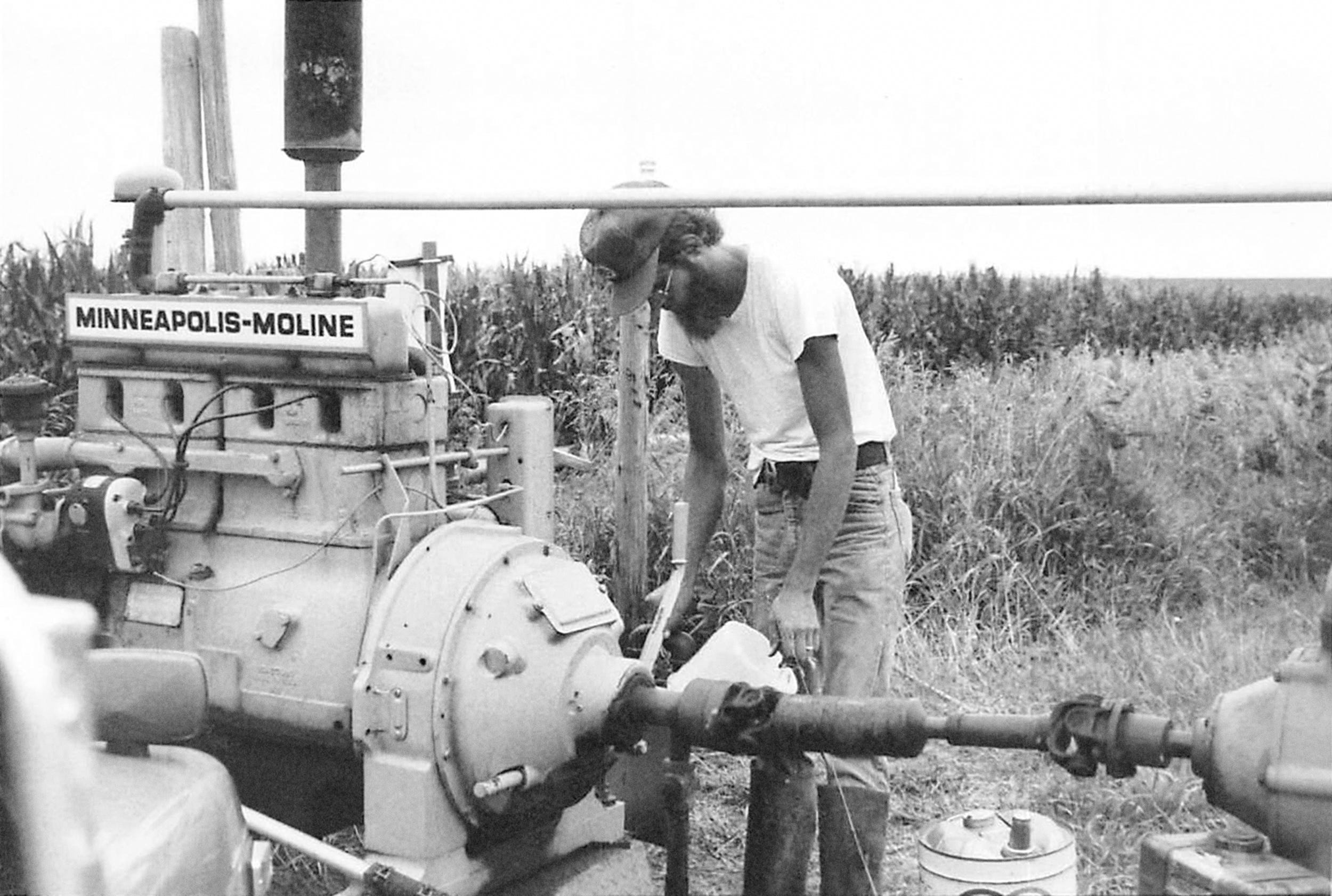
JAY: And there’s, I think, 100 rows in the field. but yeah, it takes a lot of monitoring, especially the first time across because you just, you don’t really know what to expect, and you haven’t done it for a year. So you’re trying to remember, “Okay, how far did I open them?” And you got a pretty good feel, but you guess, and then you go out in two hours, and you drive to the end of the field, and then you walk in. You see how far has the water made it. “Do I need to let it run for another two hours? Or is it already here that I can just go idle the gates back now so we can really let it soak in?” It takes a lot of monitoring. Right before I came out here, I was talking with Adam about the irrigation motor. You can probably kind of hear it droning on in the background. It’s it’s an old tractor motor is what it is. Minneapolis-Moline.
MOLLY: Actually, the Zoom noise functions are working really well, and I can’t hear it.
JAY: Oh, you can’t hear it. Well, that’s good. I was trying to stay away from it because it’s pretty deafening, but it’s, it’s just a tractor engine that sits there. So it’s just like any other vehicle motor. You got to change the oil. You have to change spark plugs, you know, and we were talking about all that kind of stuff, like the maintenance that it takes to sit there and run. because it’s running 24 hours a day, when we’re irrigating. We just did the math for fun. If you’re driving down the road at 70 miles an hour for 24 hours a day, that takes... What did we say? I think that’s 8,400 miles in a week, you know?
MOLLY: Mm-hmm.
JAY: So that’s, that’s a lot of miles you’re putting on. You know?
MOLLY: Right.
JAY: I put it in that perspective, um-
MOLLY: And only during, like, two months of the year, and then it sits idle the rest of the year.
JAY: And it sits. Yeah. Yeah, exactly. But so anyway, that’s the big thing on our, on our docket today. We actually moved cows this morning before it got hot. They were-
MOLLY: Mm-hmm
JAY: They were done in the paddock that they were in now, and so we moved them out towards the permanent pasture where they will be for the next, about one day in each paddock out there. And so they’ll be out there for about a week maybe, before we move them back into some of the other pastures that we have planted, some of the perennial pastures out here.
MOLLY: And when you’re just going from paddock to paddock, it’s easier moving than when you’re going across the farm?
JAY: Yes. Yeah. where we moved today, it was, it was actually a different field, but it was only a couple hundred yards. It was a pretty easy... Today was a really easy move.
MOLLY: Good.
JAY: I, you know, it took us 15 minutes to move them today. Sometimes it can be an hour and a half, two hours to move, but some days everything aligns and it all just goes easy, and all the cows are hungry and they want to move and so they do. Other days they’re just, they just wanna mosey around and take their time. But-
MOLLY: Well, I’m kind of the same way.
JAY: Yep. We are not all that different I don’t think sometimes.
MOLLY: Uh, well, thanks for taking a minute to check in. I really appreciate it.
JAY: Yeah. Absolutely. Okay. Thank you. Have a good day.
MOLLY: Have fun irrigating.
JAY: Yeah. Thank you.
MOLLY: Bye.


