
Transcript
JAY: Hello.
MOLLY: Hey, Jay.
JAY: Hi.
MOLLY: How’s it going?
JAY: It is going well.
MOLLY: Can we talk a little bit about your transition in your job?
JAY: Yeah.
MOLLY: When you came to Grain Place, your primary work was really as, like, a community builder, a liaison to other…
JAY: Yep.
MOLLY: Folks interested in transitioning to organic.
JAY: Yeah.
MOLLY: The last weeks, months, you’ve really been out in the field working,
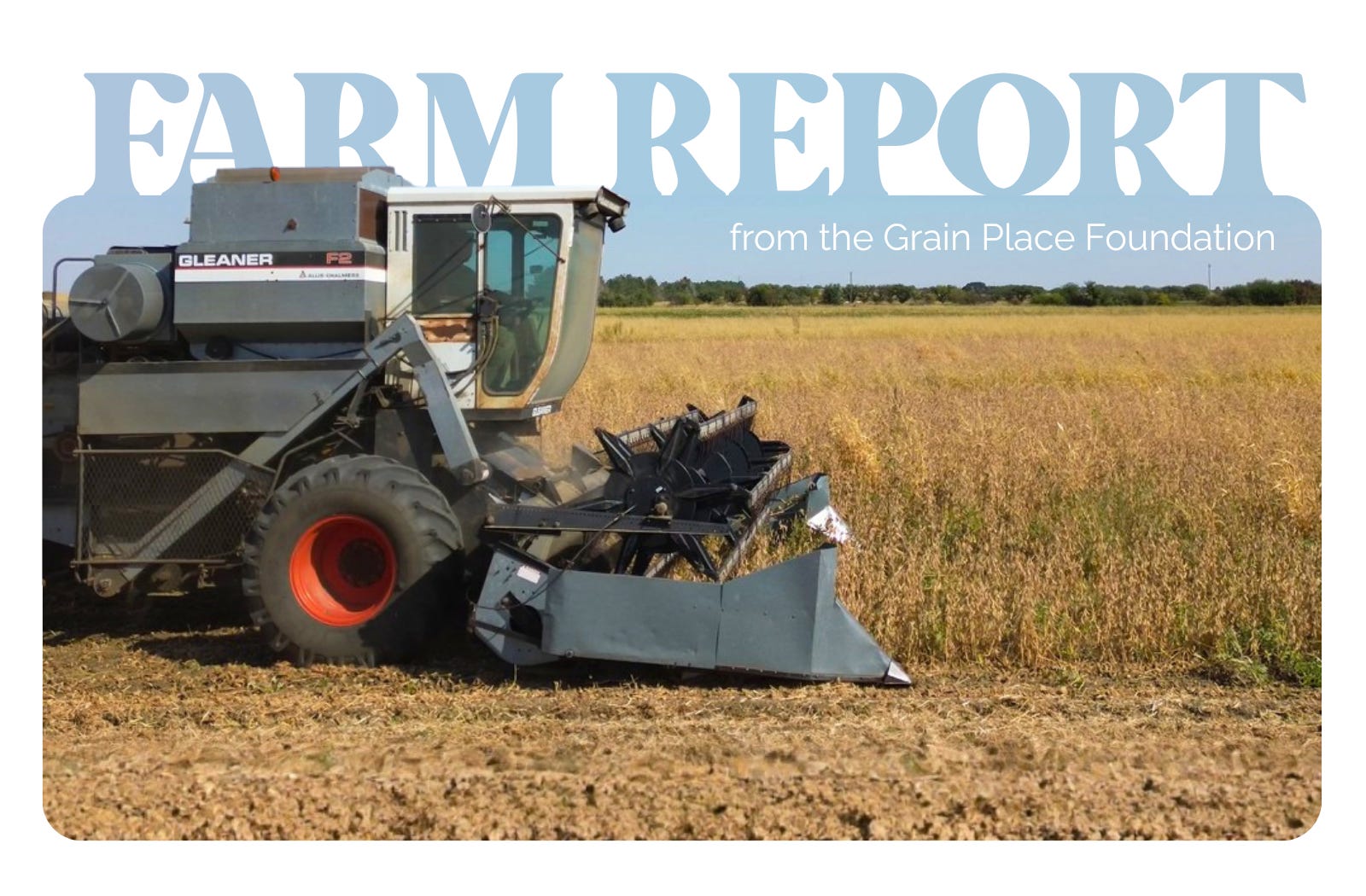
JAY: So the seasons of farming the workload changes with every season. We had one farmer retire in December, and while we were looking for a second farmer—to help Adam—because the Grain Place is such a complex farm, it really can’t be done with one person. It really needs two people—two full-time farmers. And so I was filling in a lot of time, for the last few months out there, especially during the planting season, getting fields prepped for planting. ‘Cause when you’re organic, everything takes a little bit longer because you’ve got multiple passes over the field with your implements to try to till up the field and get the weeds under control and all those kinds of things, which your conventional neighbors would be, you know, spraying with their 100-foot sprayer, and do what I do in four hours, they would do it in 30 minutes. And so there’s a big labor requirement. And so I was filling in a lot of that requirement—alongside Adam—so that we could just keep things going and get things in the ground. And then we recently hired somebody. So we have a new farmer, Rusty. And so now I’m transitioning back into more outreach and education. My main goal when I was hired on was to reach out to interested farmers, guys who are—girls, guys, everybody—who is interested in farming in a different way. Maybe they’re conventional right now, but they’ve observed something that they don’t like in their field. They’re noticing that, “I don’t know if I wanna keep using the chemicals and the pesticides and fertilizers and stuff.” And so they’re curious and they’re asking, “Well, how do I, how do I start making some of these moves towards organic? So I’m transitioning back a little bit more towards that role. I’ll be spending a little bit of time out on the farm as needed when they need an extra set of hands. But, for the most part, I will be going back to meet with—I’ve met with some college classes, some tour groups out to the farm. So just a lot of teaching about, “Hey, this is how nature’s system works, and this is how farming works, and how do we try to find that spot in the middle where we can raise a crop without disturbing nature as much as possible.” I farmed for about 17 years or so, and I grew up on a farm, so I’ve always done it my whole life. But, I enjoyed the tractor time. I always enjoy listening to podcasts and stuff like that when I’m on the tractor. It’s a good time to read a book when you don’t actually have time to read, did some interesting listening and learning.
MOLLY: There’s not, like, a risk of wavy rows if you get too distracted?
JAY: Well, you know, there’s probably always a little risk, but most of what I was doing wasn’t planting. Adam did most of the planting. I was doing mostly the discing, and those rows, you can’t tell in the end when they’re—they eventually all come together. But yeah, no, that was fun. It was fun to get back out and see tasks get accomplished, you know, in a real definite way. And, honestly, being on a farm farming with other people is always more enjoyable than farming alone. And most of my farming, I did farm with my dad, but, as he was transitioning out… You know, a lot of my farming I felt was on my own.
MOLLY: Mm-hmm.
JAY: But I always harvested with my cousin. Growing up, we planted and harvested with my uncle and cousin as well. And harvest was always more enjoyable because it brought more people together. So all of a sudden it’s this team effort. I remember joking with him a few times that, you know, something would break, and nobody likes breakdowns, but when you’re with somebody, it’s not quite as bad ‘cause you’re not out there alone at 9:00 at night.
MOLLY: Yep.
JAY: But, you know, if someone’s beside you, at least it, it... I don’t know. For me, it seemed to temper that a little bit and just, “We can get through this. We can figure this out,” you know? And there, there’s something about that. So being out there on the farm with, with Adam and with Glenda and the other people who came out and helped, from time to time, it was good. That part of it was it’s a cool thing.
MOLLY: I mean, I suspect there’s long tasks that are always fairly solitary. I mean, when you’re driving- the tractor around and around the field, you’re not...
JAY: No, exactly. You’re out on your own but it was still the fact that somebody else is there on the farm. If something did break, you could call them and say, “Hey, I’ve gotta fix this thing. Can you come help me? Because, this is gonna take me three hours alone or 30 minutes if I’ve got a second set of hands,” but the problem is with so many farms these days is, they’re pretty big farms, but the efficiency factor that has been designed and sold to us as people, farmers, everything, it takes away the need for that second person most of the time.
MOLLY: Yeah.
JAY: But there’s still places you always need it. And so in my context on my own farm, I farmed about as much as I could do alone. But I didn’t have enough to hire somebody.
MOLLY: Mm-hmm.
JAY: So it was that funny balance of like, well, if I’m gonna hire somebody, I gotta pick up a whole bunch more acres. Then it’s like I don’t wanna pick up more acres ‘cause then I’m even more removed from the ground, and then I’m even more scattered. So it’s a challenging balance, being on a farm and finding those places where—you know—where you can collaborate.
MOLLY: I just imagine a sense of tremendous pressure on a person making all those choices alone. Just like having someone else sign off on the choice, even if you’re not making the decision together, if there’s someone else you tell your plan to and they don’t say like that’s a horrible idea, then it’s, I don’t know, it just relieves a little bit of that stress.
JAY: You know, in some ways farmers are fiercely independent. You know? So in some ways it’s like, “Well, I don’t want my neighbor’s opinion or this other guy’s opinion. I just wanna make the choice and do it.” But there’s a big truth to being able to bounce an idea off somebody. Or, like on the Grain Place, it’s such a diverse farm. There’s a lot of different things you could do, and they’re all important. But if you’re one person on that farm, boy, that would be hard because you can only do one thing at a time. Now if there’s two of you, now you can come together and you can say, “Hey, we’ve got these five priorities this week and the weather looks like this.”
MOLLY: Mm-hmm.
JAY: “Crops look like this. The cows look like this. This is how we’re gonna prioritize. You go do that, I’ll go do this.” And the beauty of having another person is that I can never think of everything, you know?
MOLLY: Right.
JAY: Everybody has their own little bit of a bent in to where their mind just naturally goes to and what they focus on. And sometimes for me that’s, I don’t know about wrong, but it’s not the complete picture. There is a lot of people who are talking to neighbors, to crop consultants to extension agents but it’s always a little bit more challenging if you’re calling a crop consultant who’s employed by the people who sell you the products.
MOLLY: Right.
JAY: There’s a little bit of conflict of interest there. Not that they’re lying to you…
MOLLY: But they just have a different motivation.
JAY: There’s a different motivation. You know, if, say you go call an extension agent, well, they don’t sell them to you, so they’re not, they don’t have any advantage and
they’re not gonna lose business if they give you advice that is more conservative. But your chemical dealer, if they give you real conservative advice and you get eaten up by bugs or something ‘cause you don’t spray them, you’re gonna remember that and you’re gonna be frustrated.
MOLLY: And on the one hand, the cellphone makes it easy to reach out to someone. But on the other hand, it could be someone anywhere, which is different from someone who’s in it with you.
JAY: Correct.
MOLLY: Like on the same land or your neighbor. It’s a different view you have when you’re closer in to each other.
JAY: Absolutely. Yeah, and it’s, and it’s amazing how your context, even when, even if your neighbor turned to organic and was organic, you’re still in a different context, it is very, very context-specific, and a lot of that stuff does come down to just the farmer’s judgment call on say, a soil condition call or things like that. I mean, you can gather a lot just by driving down the road, too. You know, you see what other people are doing and you can be, “Oh, yep- Right ... it’s time to be working on this,” or everybody gets to know that neighbor who’s always the first one to run the pivot or the first one to get out in the field planting, and you’re like, “Okay, well, now it’s two weeks later for me.” I had a neighbor that farmed a lot of stuff around me, and every once in a while we’d stop on the road and just chat, and we always thought everything was going so smooth for the other person, ‘cause they’ve always made it look so easy, you know?
MOLLY: Right.
JAY: And then they had all the problems they were dealing with, and I had all the problems I was dealing with, you know, you don’t always see that they have all the struggles, too. Going out and talking to other people gives you that perspective too that, hey, this is, this is a challenge for everybody. My uncle always told me…
MOLLY: Right
JAY: You can’t buy yourself out of repairs. So you can go buy brand new stuff, it’s still gonna break.
MOLLY: That sounds like a truth.
JAY: Yep. Cool.
MOLLY: Uh, anything else you wanna talk about today?
JAY: I think that probably sums it up.
MOLLY: Well, thanks for taking time out from the your time indoors to check in today.
JAY: Yep. Thank you.
MOLLY: Take care, Jay.
JAY: Yep. Yeah, have a good day. Thank you.


